
A brief comic featuring my character Balinac as a Manga style schoolgirl.
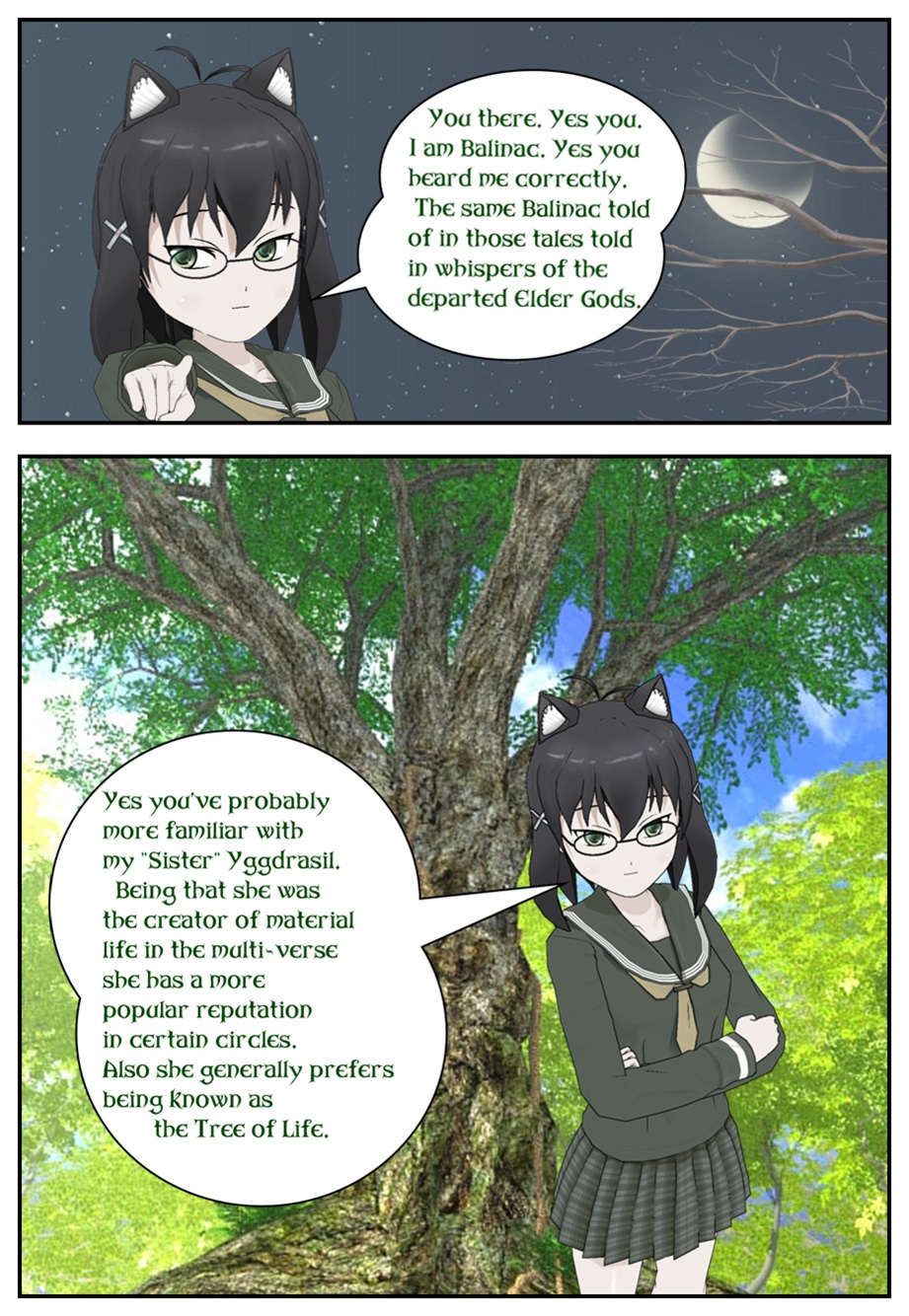

A brief comic featuring my character Balinac as a Manga style schoolgirl.
It may be surprising to some, but I like to play games. I like board games, pen and paper games, and, oh yes, video/computer games. One game I’m looking forward to can be found on the https://robertsspaceindustries.com/ website. It is called Star Citizen. It is a space combat/sandbox simulation created by Chris Roberts of Wing Commander and Freelancer fame.
Well they have a forum on the game development site, and yes that forum has a fan fiction section. Being the kind of person I am, I wrote a fan fiction on their forum which blends together the Star Citizen space opera setting with my own Fantasy worlds found in the Tales from the Reading Dragon Inn setting.
The short story The Dead Men of Coffin Company can be found in .pdf form linked here, and in my short story section of this site found on the menu bar above (on the top right). I hope my readers enjoy my attempt at stretching out into Science/Fantasy instead of my usual Fantasy offerings. I’ve always intended to move my Tales from the Reading Dragon Inn setting through various genres over time, and this is the first jump into Science/Fantasy. The upcoming Triskaidekaphilia will be broaching the Steam Punk/Fantasy divide. I hope you find it interesting.
A long time friend of mine from our mutual high school days has decided to create a new blog about his Restoration and Rehabilitation of his mothballed Ducati motorcycle. I told him to give me the link when he gets his blog started, and now I am posting it for the enjoyment of motorcycle fans, and 1990’s Ducati fans in particular.
This started as a response on Steve Thomas’ web blog (found here) about the writing process:
I find my creative process is just that, my own process. I also like discussing other people’s processes, but most times I know that it will have incompatible elements with how my own muse works.
For example when writing fiction (in particular fantasy) I find that I can not even begin if I start by envisioning a plot. In my mind story is never about plot. Plot is a framework. Story is about character. If as an author I haven’t conceived a fairly detailed understanding of three key essential characters, then I can’t begin to write a story.
The first and formost important character is the narrator. Yes, that’s right, the narrator is the most important character in fiction in my mind. If you don’t understand your narrator and their relation to the story, then I believe you’ll do less than your best when writing. The narrator is the voice which carries everything. That voice has to work, or else the story won’t.
Some authors automatically default to their own voice, and thus in essence they become the default narrator of every story. This is certainly allowable, and if the author has a good voice it may work quite well. Myself I like to play around with the narrator and their relation to the story.
For example: in my first novel my narrator is second person, not involved in the story. The conceit as I write is that the narrator is relating the story from a point in the distant future from the story to a small intimate audience at an Inn. I never write that explicitly in the novel, but that is constantly in my mind as I wrote the story. The narrator doesn’t have access to the internal monologs of the characters of the story, and some events are portrayed in archetypical ways because the narrator is dealing with a story from what is his distant history learned second hand. Thus the narrator is deliberately inaccurate with some details, and deliberately skips events he doesn’t feel are relevant to the story he wants to tell his audience at the Inn.
In my second novel my narrator is first person, and the protagonist of the story. The conceit is that the narrator is now telling his personal story from a point in the near future to their same small intimate audience at the same Inn as the first novel. So in two different novels with different characters, different protagonists, I’ve kept the same narrator, but I’ve also shifted to a first person narrator who knows his own internal monolog. The narrator selectively shares some of what he was thinking, and selectively edits portions of the story to keep certain details hidden, or to move the pace along.
The second character I need to envision is the protagonist. The person who will serve as the focal character of the story. I have to know the protagonist’s mind, their philosophy, their behaviors, and their desires. I don’t need to lock in an appearance at first, but it tends to come with time. Once I know how that character thinks, I can start writing scenes with that character because I will be able to introduce a stimulus (or event) into the scene, and I will know how that character will react to it.
I still can’t write a story until I understand the antagonist. Sometimes the antagonist is the least understood, but they generally have to have a goal, and they have to be the kind of person/event/happening which provides the conflict of the story. Sometimes the antagonist comes in multiple parts such as hostile beings, unfortunate happenstance, and beings with conflicting objectives. Sometimes the protagonist becomes their own antagonist because of conflicting desires. The main point is that without understanding the source of conflict, you can’t have a story.
Another thing I’ve done with my first two novels (besides making them independent works set in the same “multiverse” setting) is to make certain the narrator stays with the protagonist in every scene. When the protagonist leaves the scene, even though I know as the author what else may be occuring outside of the protagonist’s knowledge, the narrator stays with the protagonist and limits you to their understanding of the story.
This is all to set up my third unfinished novel also set at a later time in the same “multiverse”. Once again I am using the conceit of a second person narrator (the same narrator who is the second person narrator of the first novel, and the first person narrator of the second novel) yet they are now a second person narrator with limited second person omnicient views of the main protagonist and now sub protagonists of the story. Yep, I’ve gone down the path of multiple protagonists, and now each protagonist can be followed by the narrator, and the narrator can alternate between the main and sub protagonists as he is now telling essentially five different interwoven stories in one novel. Also the narrator actually shows up in the third novel as a tertiary character in a couple of scenes.
The novels are all told as “Tales from the Reading Dragon Inn” which is the sub-title of the series I am writing. Yes, it is strange to think this much about how the story will work in ways the reader will never actually see or likely understand, but that is why writing is such an individual process after all.
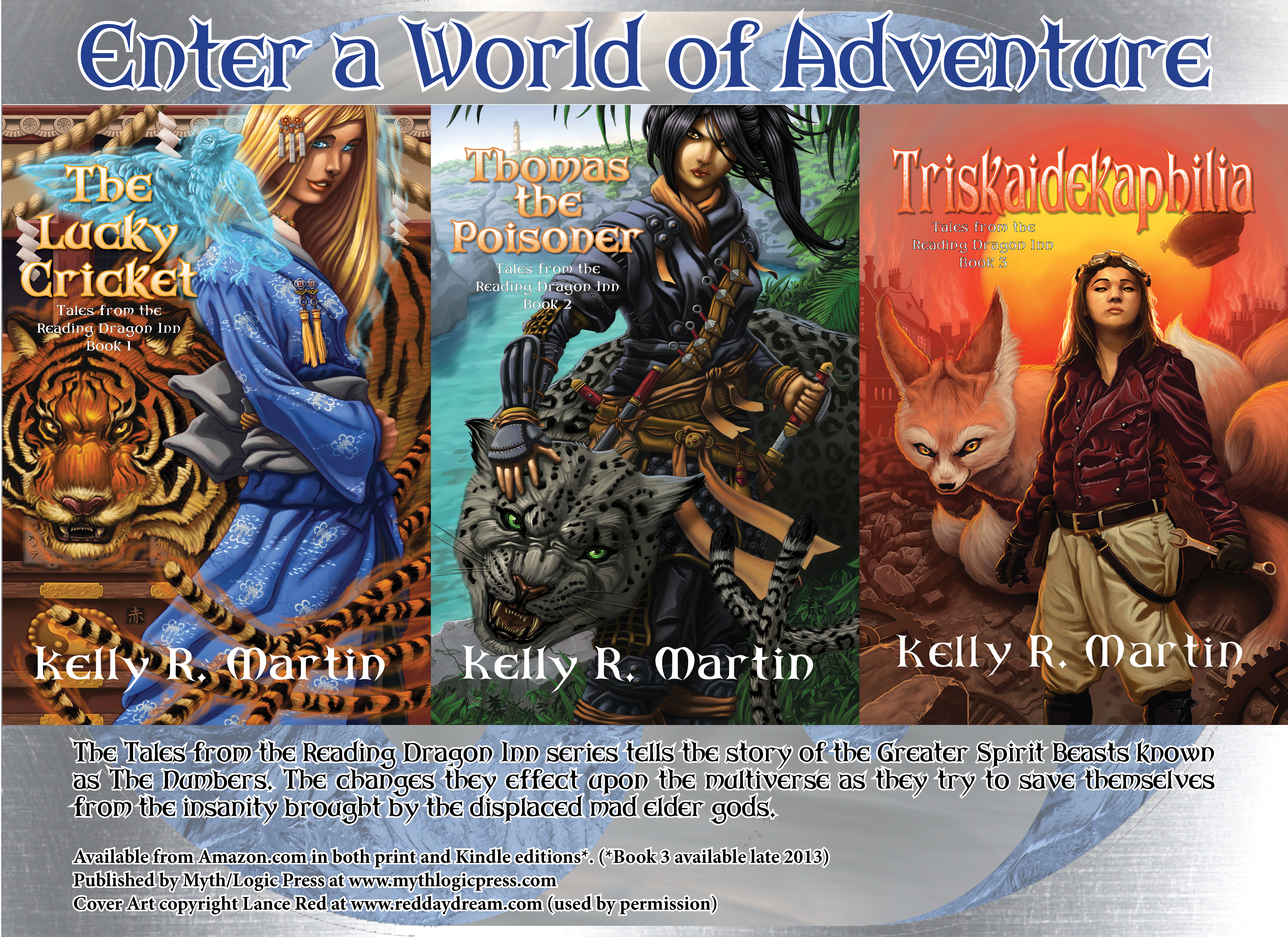 Myth/Logic Press is sponsoring the upcoming Evil Inc comic by Brad Guigar at www.evil-comic.com for their May edition with the above advertisement. I’m looking forward to some more joint venture promotions in the future, and I hope this can be a good one for me as well. I’ve been following Brad Guigar’s Evil Inc web comic for a good number of years now, and I’d recommend it to anyone who is a fan of humorous super villain characters.
I have been teasing some updated book cover art with my banner for a while. Well by December 2012 I plan to actually switch the covers over to the new style. They are all the work of the tallented Lance Red of www.reddaydreams.com and I am proud to show you the poster I am going to use at my upcomming appearance at the West Virginia Book Festival in Charleston West Virginia on October 12th and 13th 2012.

I just wanted to mention that I have linked two new works by Author Gary Lee Vincent, and one new work by Richard Bottles Jr. in my Amazon A-Store (on the right->). The works Darkened Hollows, and Darkened Waters finish the “Darkened” West Virginia Vampire series by Gary Vincent. While Hellhole West Virginia continues Richard Bottles exploration in to the depths of human depravity.
All of their works are for mature audiences only, with a definite NC-17 rating for their graphic depictions. These are writers who are not for the faint of heart. I encourage you to check them out at www.burningbulbpublishing.com and I hope you enjoy what you find as much as I have.
I attended the SciFi in the Valley convention in Ebensburg, Pennsylvania this May 18-20, 2012 weekend. As part of my post convention report I want to thank my booth neighbors Jeanne Powell Ogden and Tammy C. McMullen for putting up with my usual convention antics. I also spent a fair amount of time talking with Gary Lee Vincent and Richard Bottles Jr. over at Burning Bulb Publishing, and one of my favorite artists Chris Dame. As usual photos can be found Here!
The other good folks I met include:
Comics artist Dan Nokes at 21sandshark.com
Geek Girl Project – Allie O’Neal at thegeekgirlproject.com
Glenn Barbis Jr. at Facebook
Greenman Hero for Hire at greenmanisreal.com
The good folks at www.hungarianwandshop.com
Jeremy McHugh at www.mchughstudios.com
The folks over at RKYV Online
Stan Gordon of Stan Gordon Productions at www.stangordon.info
And finally last but not least Joe Kleinman of the web comic Wootlabs.
The WordPress.com stats helper monkeys prepared a 2011 annual report for this blog.

Here’s an excerpt:
A San Francisco cable car holds 60 people. This blog was viewed about 1,700 times in 2011. If it were a cable car, it would take about 28 trips to carry that many people.


 Myth/Logic Press
Thought(less?) Experiment
What separates someone from a community?
An inability or refusal to adopt normative behaviors is one possible answer.
What started this experiment?
A post by a blogger Joe Peacock on the CNN “geek” column, led to an uproar in the self proclaimed “geek” community. I wasn’t concerned with the uproar in this particular case, but I was interested in the self identification as “geeks” vs. my own self identification as a nerd. My initial post on the whatever.scalzi.com web site was as follows:
From my personal perspective I refuse to accept the title “geek” because I’m enough of a nerd that I understand the original definition of the term (a carnival side show entertainer who bites the heads off of live chickens). I do accept the term nerd because it is an originally non-deragatory term created by nerds and adopted by nerds. I am also a fanboy and an otaku. I find the term “geek” to be as personally offensive as racially insensitive terms objected to by other groups. Certainly other groups do sometimes adopt and attempt to own derogatory terms for themselves, but I don’t feel a personal need to do so.
So if you want to adopt the term “geek” for yourself in an attempt to own a deragatory term, then you are free to do so. I personally will object to the usage in my case, and correct the mistaken person using the tem in relation to me. That is one element of my personal nerddom.
Thank you.
I was subsequently challenged because someone using the modern definition of “geek” as a fan of a particular topic/subject/media type was the same as the japanese term otaku. That lead to my reply:
From Wikipedia:
Geek,
In 19th century, in North-America, the term geek referred to a freak in circus side-shows (see also freak show). In some cases, its performance included biting the head off a live chicken. The 1976 edition of the American Heritage Dictionary included only the definition regarding geek shows.
Otaku,
Otaku is derived from a Japanese term for another’s house or family otaku, which is also used as an honorific second-person pronoun. The modern slang form, which is distinguished from the older usage by being written only in hiragana or katakana, or rarely in rōmaji, appeared in the 1980s. In the anime Macross, first aired in 1982, the term was used by Lynn Minmay as an honorific term. It appears to have been coined by the humorist and essayist Akio Nakamori in his 1983 series An Investigation of “Otaku” “Otaku” no Kenkyū?, printed in the lolicon magazine Manga Burikko. Animators like Haruhiko Mikimoto and Shōji Kawamori used the term among themselves as an honorific second-person pronoun since the late 1970s.
My reply:
In the first case Geek started as a deragatory term which a group adopted in defiance of its deragatory usage. In the second case Otaku started as an honorific term which another group later tried to turn into a deragatory usage, and the orginal Otaku fought to take the term back into the honorific usage. I’m a bit of a language nerd and this is why I am careful to understand the meaning and usages of terms (and their accuracy) before applying them to my own person. You are welcome to adopt a demeaning pejorative term as your own. I personally choose not to do so. I also choose not to allow people to change a non-pejorative term into one when I use it for myself.
Otaku in modern slang is much closer to fan (fanboy, fangirl) than it ever was to a sideshow freak which would bite the heads off from chickens. The deragatory nature was applied by “mainstream” culture which didn’t understand the cult like obsesion with certain off mainstream topics by fans. In the American usage of the term it is used to differentiate a fan of items frequently of interest to Japanese Otaku culture. Thus since I watch and read several japanese anime and manga the term is an accurate usage for me in this case.
I understand that geek in modern slang usage is also equavalent of fan (fanboy or fangirl) but the derivation from the original deragatory usage is why I object to it. I have never been someone who performs sick self debasing acts for the entertainment and thrill of “mainstream” society. You are welcome to call yourself a geek if you choose, and I will continue to call myself a nerd and object with lenghty clarifications about the differences between the two.
Thank you.
That was pretty much the end of my point, and it didn’t lead to any particular controversy on the comments page of the “whatever” site. Then the idea for the thought experiment began. What was the reason a more modern geek as an obsessed fan of a subject was linked in with the “historical” definition of the sideshow performer who fascinated and repulsed people at the same time?
Well the whole point of this orignal article on “whatever” was based on Joe Peacock writing something both insulting to women, and revealing his “geek” nature at the same time in his CNN column.
I then started to formulate how to best demonstrate the true nature of being a “geek” in a more classical sense vs. being the modern definition of someone who is a fan of a subject. Then I would test a community full of self identified “geeks” of the modern definition to see if they too would either accept a “geek” in the more classic sense of the term, or reject someone going against the normative behavior for their community.
The Methodology:
The question became one of how to bite the heads off of metaphorical chickens on a web page comments section. In the classic sense a “geek” is unpopular not because of his interest in an off beat activity, but because that activity is considered breaking normative behavior in a repulsive manner. A person being a fan of watching a particular Sci-Fi program may be doing something which isn’t particularly normative, but most people in these days don’t consider it particularly repulsive. In some cases interests formerly considered not being normative have even become clearly mainstream and fully normative interests.
So what is unpopular within a web forum community? Some of the activities are as follows:
1) Trolling – also known as intentionally riling up negative emotions in other people for personal entertainment.
2) Picking a contrary point of view against the forum community norm. (Often considered a form of Trolling).
3) Taking other people’s statements out of context, and appying a derogatory interpretation to their remarks.
4) Attributing motives, thoughts, beliefs to someone they don’t actually have.
5) Inconsistency of position on a topic.
6) Claiming the moral high ground over another person’s point of view.
7) Defining yourself as holding a superior position intelectually over another person.
8) Refusing to acknowledge the points made by another person with a contrary point of view.
9) Using spurious logic to make inconsistent points.
10) Quitting the discussion at hand and running away while crying foul.
I had my “geek” behaviors lined up, but the question was how to take the next step and go from being merely unpopular to repulsive. I used Joe Peacock’s own “geek” behavior as my initial guidepost. Saying something unpopular was going to have to be part of the formula. Yet standing up for someone who had already repulsed the community was going to make the “geek” happen.
If anyone is particularly interested in the resulting trainwreck created, then they are welcome to go over the comments section on “whatever” and have fun identifying each of the places I applied one or more of the approaches above. What I found fairly interesting myself was the number of times the other members of the community responding to me used the some of the same approaches, and other approaches I didn’t attempt to use.
The Observation:
When someone comes into a community as an unpopular “outsider” who doesn’t follow their normative rules an interesting set of behaviors begin to manifest. The first is people generally ignoring the outsider until something “repulsive” is seen. In this case I barely caused a splash at all until I stepped into the community with a defense of Joe Peacock’s right to be unpopular with his point of view. My repulsive behavior in defending Joe Peacock’s right to be a “geek” in the more classical sense of the term caused a much greater reaction. It was pretty quickly “repulsive” by association.
It didn’t take long before people began to attribute Joe’s repulsive remarks (which I didn’t repeat or even attempt to justify) as part and parcel of my own position. I was categorized in with Joe repeadly as part of the outsider group. Then as more people began to establish themselves as parts of the normative portion of the group, the behaviors listed above actually became the more normative behaviors of those individuals beginning to address me. This was the fascinating portion of the thought experiment to me. That several parts of my chosen behavior set was adopted by the very people who were rejecting my inclusion in their community.
The next part is also quite fascinating. As more people came out to join the normative group in repudiating my stated position, others began to step away from commenting on the original controversy. Soon the primary controversy which had led to comment section had subsided beneath the new controversy I had created by taking an unpopular position on the issue.
Another point of observation was that the few people who early on were attempting to moderate the behavior of people against my point of view began to leave the discussion rather than risk being grouped into the repulsive category. Once it was clearly established I was the outsider, fewer people to eventually no people were willing to step up and risk getting grouped in as an outsider with me.
The Lesson Learned:
Even in groups which choose to self identify as “outsiders” to the broader mainstream community at large, a failure to follow normative behaviors, and an association with behaviors considered repulsive leads to rejection. This rejection even takes on the form of bully-like behaviors which are often the same behaviors the “geek” community complains about from the mainstream. The attacks against the outsider become more agressive and more numerous as a larger “alpha” group appears to dominate and ostracize the outsider.
p.s. people are welcome to comment here. All comments are moderated by me to determine whether the content is constructive before being presented on the page here. People are of course entitled to their freedom of speech. and I encourage them to set up a web site of their own to exercise it. I am not required to allow my web site to be the open pulpit for anyone to exercise of their freedom of speech.